
Small Team, Big Output: How AI and Automation Make Your People Better, Not Redundant
AI isn’t coming for the person who knows how your business works. It’s coming for the boring parts of their day.
Walk into any company - a clinic, a law firm, an online shop, a warehouse - and you’ll see the same thing. Your best people spend hours on work that doesn’t need them: typing the same data into three systems, chasing documents, answering the same question for the tenth time.
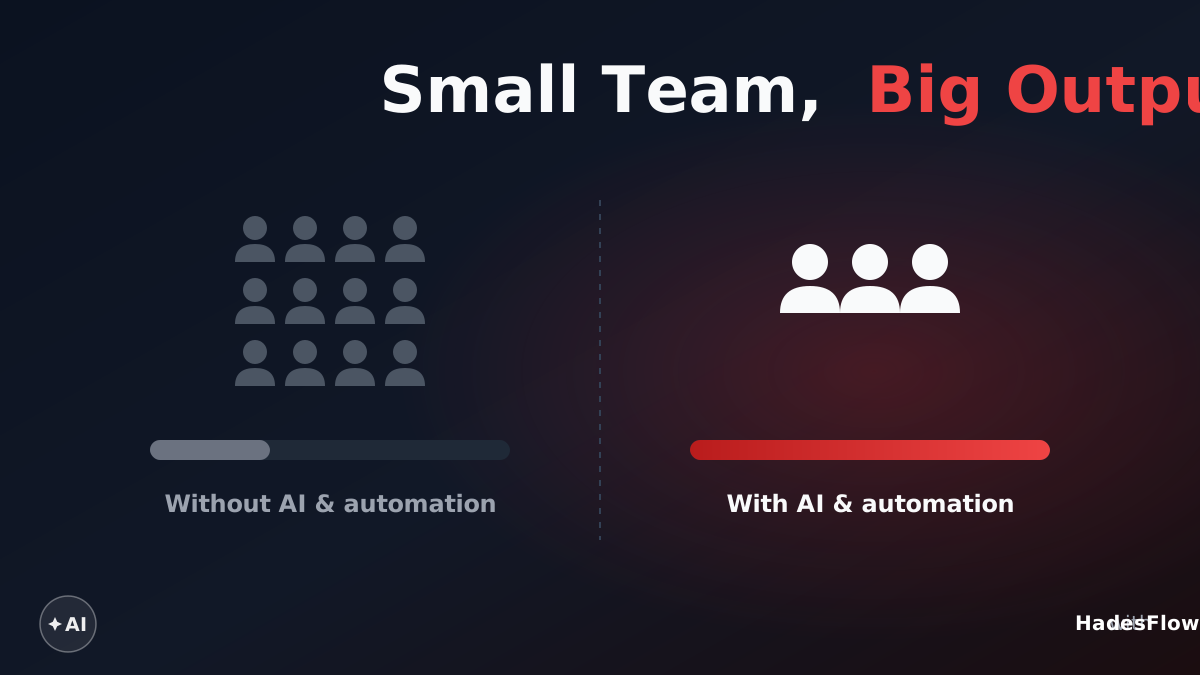
Take that work away and nobody becomes useless. The same people simply get a lot more done. A team of five handling what used to take fifteen isn’t a slogan - it’s the kind of change we see once the busywork is gone. That’s the whole business case for AI: small teams doing big work.
How it works, in plain words
You don’t need to understand the technology to use it. Almost everything we build combines two things:
Automation
Moves information between the apps you already use - email, spreadsheets, your CRM, invoicing - automatically, day and night.
AI
Reads and writes like a person: understands an email, pulls the key details out of a PDF, drafts a reply.
Put them together and a typical task looks like this:
That last step matters. Your people stay in charge - they just spend their time on the cases that actually need them.
What to automate in your industry
Every industry has its own version of the same boring work. Here’s where we’d look first:
| Industry | Automation takes over | AI helps with | Easy first win |
|---|---|---|---|
| Online shops & retail | Keeping orders and stock in sync | Product descriptions, sorting reviews and complaints | Reminders for abandoned carts |
| Law & accounting firms | Collecting client documents, deadline reminders | Pulling key details from contracts and invoices | New-client onboarding |
| Clinics & healthcare | Appointment reminders, routing forms | Sorting patient messages by urgency - a person decides | Fewer missed appointments |
| Real estate | Saving new leads, booking viewings | Listing descriptions, first replies to buyers | Instant reply to every new lead |
| Manufacturing & logistics | Updating spreadsheets, shipment alerts | Reading supplier emails and order PDFs | No more retyping purchase orders |
| Hotels & hospitality | Syncing bookings, review alerts | Answering guests in their own language | Replies to online reviews |
| Agencies & service companies | Client reports, onboarding, support requests | Drafting answers, sorting requests | The weekly client report |
Our advice: don’t start with a big plan. Start with one annoying, repetitive task, automate it properly, and ask the person who used to do it what’s next. They always know.
Healthcare, legal and finance can use all of this too - with extra care. Keep the data on servers you control, keep it in the EU, and keep a person on every decision that affects someone. We explain the rules in our EU AI Act guide.
What changes at every level of your company
The same story repeats at every level: the same people, doing more of the work only they can do.
The biggest change is in how people think. Once a team sees one boring job disappear, they start asking “could this be automated?” before they open a spreadsheet. That question is worth more than any single automation.
Knowledge that stays in your company
Every business runs on things only certain people know: which supplier sends messy invoices, which client needs a call before an email, which step always gets forgotten. When that person leaves, the knowledge leaves too.
Automation fixes that, because the knowledge gets captured in three places:
In the automations
The way you do things is built into the automation itself. It runs the same way whoever is on holiday.
On paper
Every process gets a short, simple description: what it does, who owns it, what to do if it stops.
In your team
Your own people learn to understand and adjust the automations - not just press the button.
If the person who “just knows how it’s done” quit tomorrow, would the work still get done? If it lives in an automation and a short document - yes. If it lives in their inbox, you already know the answer.
This is why AI makes your experts more valuable, not less. Their know-how gets written down once and used a thousand times.
How we help
You can hand the whole thing to us, learn to do it yourself, or mix the two:
We build it
We build the automations and AI assistants for you, and hand them over clearly documented. You own everything.
We train your team
Hands-on workshops, then we work side by side with your people on real tasks until they can build on their own.
We look after it
We keep everything running, updated and secure, and we notice problems before you do.
Most clients start with us building the first few automations - so there’s a quick win - and then we train their team to take it further. Either way, the know-how ends up in your company, not ours.
Where to start
- Pick the most boring task. Repetitive, frequent, and done by someone who’d love to stop doing it.
- Automate it properly, with a person checking the tricky cases. Not a demo - something that runs every day.
- Write it down and teach someone to change it. If only one person understands it, you’ve just moved the problem.
Small team, big output
The companies that win won’t be the ones with the most people or the most AI. They’ll be the ones whose people know how to use it. Keep your experts, give them better tools, and let a small team do big work.
Not sure where to start? Get in touch - we’ll help you find your first task to automate, build it with you, or teach your team to do it themselves.