
Hermes - a RabbitMQ operations console
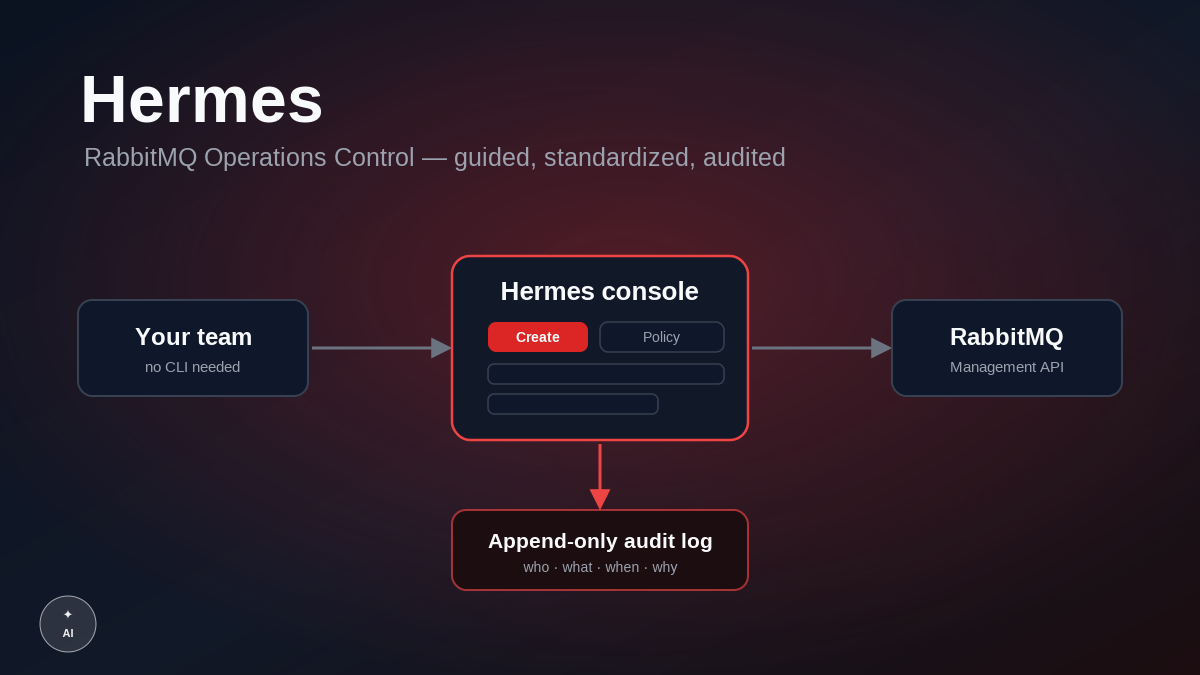
Hermes is a tool we built for our own stack - a web console that turns RabbitMQ’s admin commands into guided, standardized, fully-audited actions. We’re showing it off because it’s a good example of how we approach operations tooling: take something powerful but error-prone, and make it safe for a whole team to use.
The problem: power you can’t hand to the team
RabbitMQ is a great message broker, but you administer it from the command line - rabbitmqctl, rabbitmqadmin, or raw calls to its Management API. That’s fine for one engineer who lives in it. It’s a problem for a team: commands are easy to get subtly wrong, nothing is written down, two people do the same task two different ways, and one mistyped flag can delete a queue full of messages. The knowledge lives in one person’s head, and every change is unlogged.
What we built
Hermes replaces the write operations - the create, change and delete work - with a web interface. It is deliberately not a monitoring tool; for browsing and metrics you still use RabbitMQ’s own UI and Grafana. What Hermes owns is the part where mistakes are expensive: making changes.
Standardized actions
Queues, exchanges, bindings, policies and connections are created from vetted presets, not free-form flags. Quorum and durable by default.
Safe by default
Destructive actions show an impact preview, require a typed reason, and can run in a dry-run “safe mode” that logs the intent without touching the broker.
Fully audited
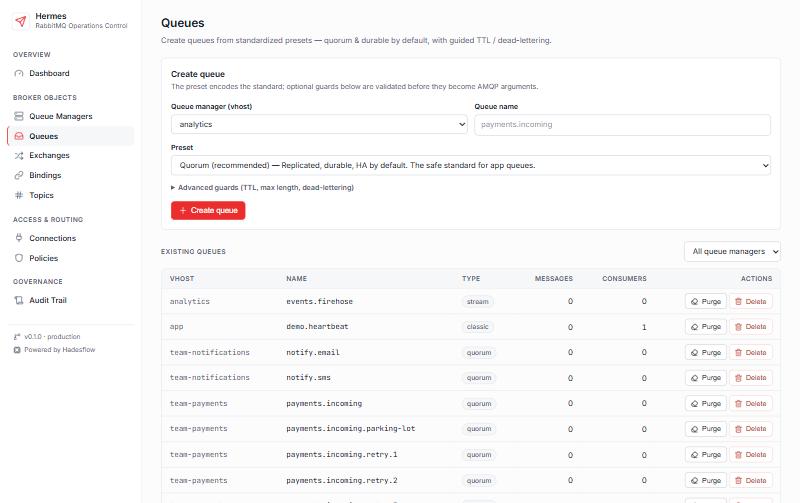
Every action - success or failure - is written to an append-only log: who, what, when, and why.
How it works
The whole thing is one small Python service. The browser talks to Hermes; Hermes talks to RabbitMQ’s Management API over the private network. One class is the single door to the broker, so auditing and validation can never be bypassed.
It runs behind the same reverse proxy and access layer as the rest of our stack, so it sits behind Cloudflare Access with no login code of its own.
Speaking the team’s language
A lot of the value is translation. People coming from other message systems think in terms like “queue manager” and “remote objects”; RabbitMQ calls those things something else. Hermes shows both names, so the tool teaches as you use it.
| What the team says | What it is in RabbitMQ |
|---|---|
| Queue manager | a virtual host (vhost) |
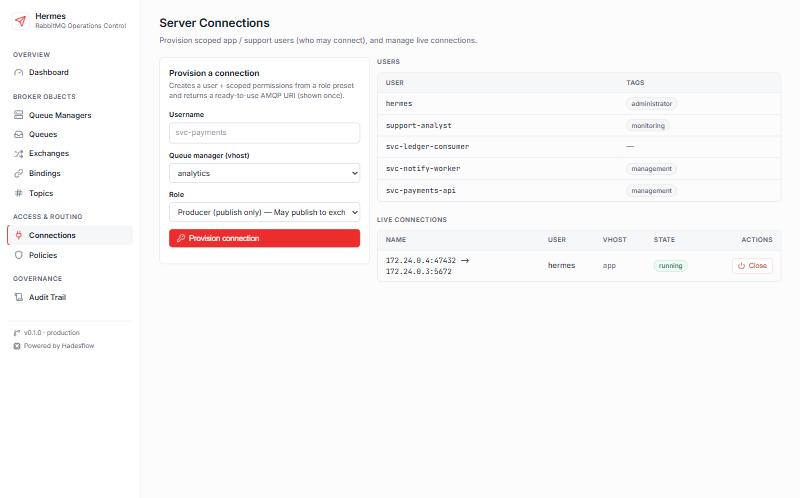
| Server connection | a user with scoped permissions |
| Local objects | queues, exchanges and bindings |
| Remote objects | federation and shovels |
| Topic | a topic exchange plus routing keys |
Every action, logged
If it changes the broker, it goes through one code path and it lands in the audit trail - even a blocked attempt. No side doors, no “just this once” on the CLI. That is what makes the log worth trusting.
The stack
Nothing exotic, on purpose. The goal was a tool that is easy to run and hard to misuse.
Pure-Python and server-rendered, with no JavaScript build step. It ships as its own isolated Docker stack and reaches RabbitMQ over a private network.
Why it’s built this way
The way it’s built is the point: abstract a sharp tool into something a team can use, make the dangerous actions safe, and log every change so there’s always an answer to “who did this, and why?” That’s the same way we build the things we run in production - like the way we run n8n.
What this shows about how we work
We build internal tools and client software, we teach in-house teams to run what we hand over, and we run infrastructure - configured, monitored and kept secure. Hermes is a small, honest example of all three in one place.
Want a tool like this for your own stack - something that makes a risky job safe and auditable?
Start a project